Featured

La Casa de las Caras: Believe it or Not, Something Weird is Happening Here

https://en.wikipedia.org/wiki/B%C3%A9lmez_Faces

In 1971, María Gómez Cámara saw a clear face form in her cement floor, seemingly overnight. The Pereira family home at Calle Real 5, Bélmez de la MoraledaJaén, Spain, became famous shortly thereafter, with Spanish newspapers coming down on one side or the other regarding the authenticity of the faces. What followed were decades of faces appearing, transforming, and disappearing. The house has been investigated extensively over the years by scientists and paranormal teams within Spain, and unsurprisingly, what determines the true nature of the faces has more to do with one’s openness to paranormal explanations than with any objective truth; when it comes to the paranormal, truth is a mixture of fraud and illumination.

Belmez de la Moraleda
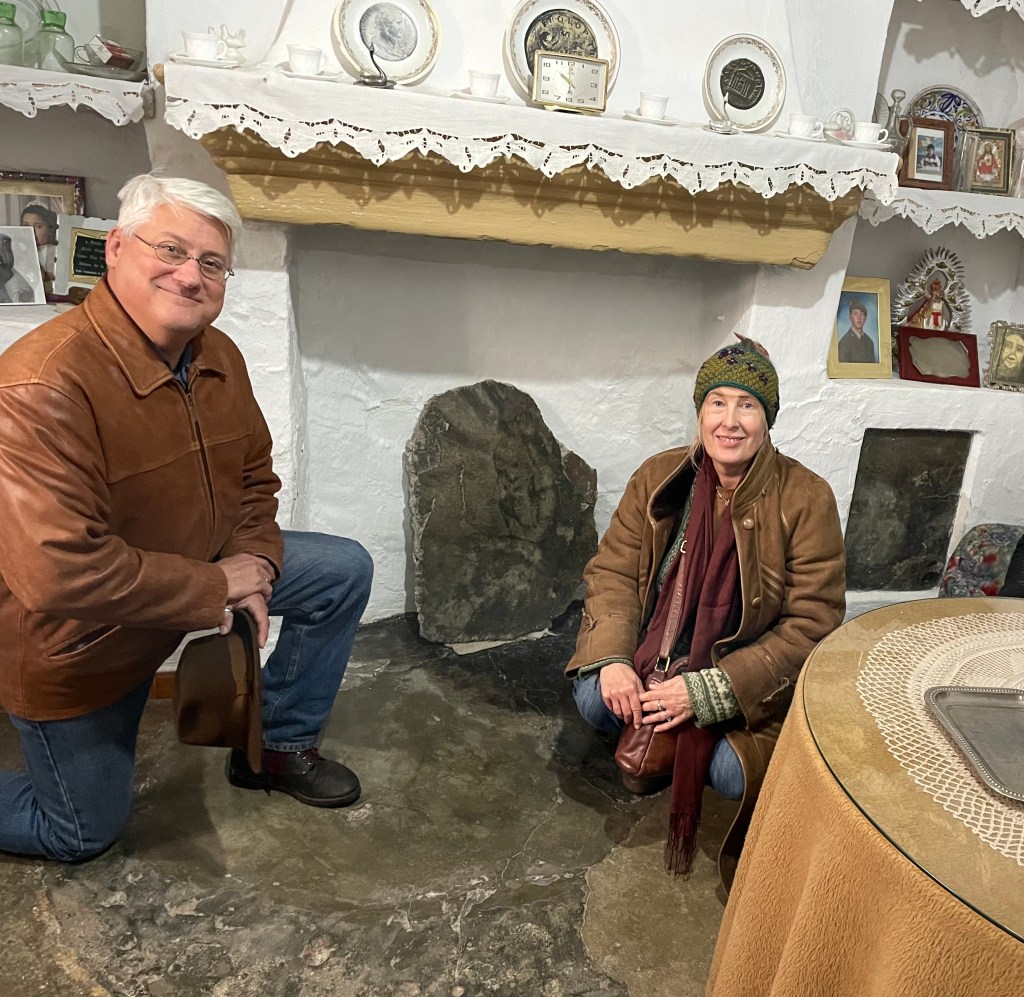
Ty and Kirsten in the “Casa de las Caras”

When we arrived, it was a blustery March day. Snow was whipping through the mountain town, and there was no sign that a famous house with hotly debated paranormal activity was just in front of us. It seemed so ordinary, unassuming, and easy to miss. After calling the number on the door, Miguel informed us that the family had just sat down to lunch, and requested we return at 3:30. If you know anything about Spanish lunches, they can last awhile. So my husband, brother-in-law and myself trudged off to find food and landed at Bar San Antonio, where everyone swiveled their heads at the strangers walking in the door. Indeed, this is a small town.

We found the one, open table and ate plates of habas con jamón y huevo  and flamenquín with a carne en salsa tapa–lots of ham, egg, fried meats and cheese. I loved it, but if you’re not used to Spanish lunch food in a small town, it’s quite heavy. While there, we discussed our hopes for the house and our expectations. My sense is that my cuñado was hoping for something haunted but not expecting it, my husband was already skeptical, and I wanted to believe that something truly weird was happening. Our expectations often color our experience.

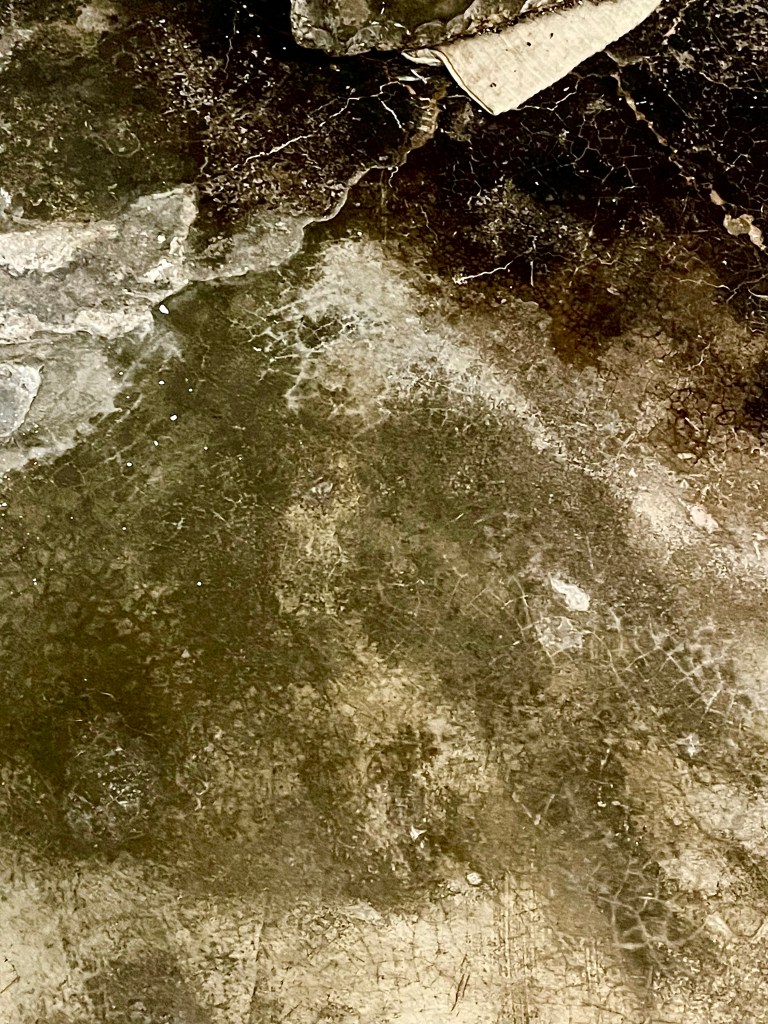
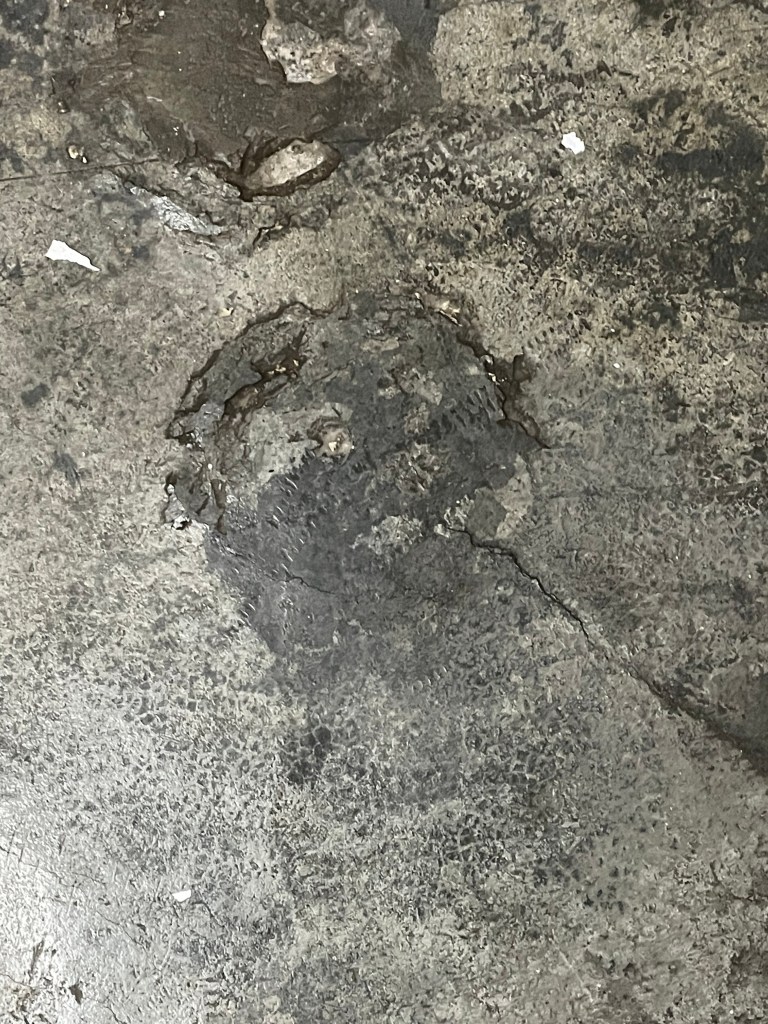
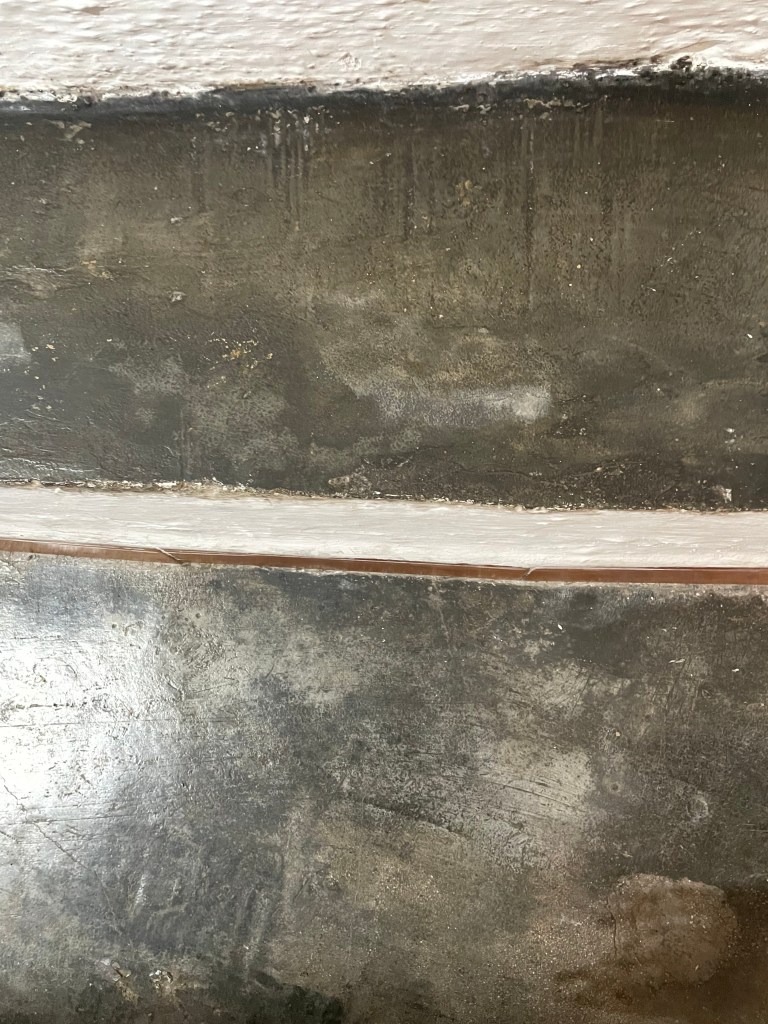
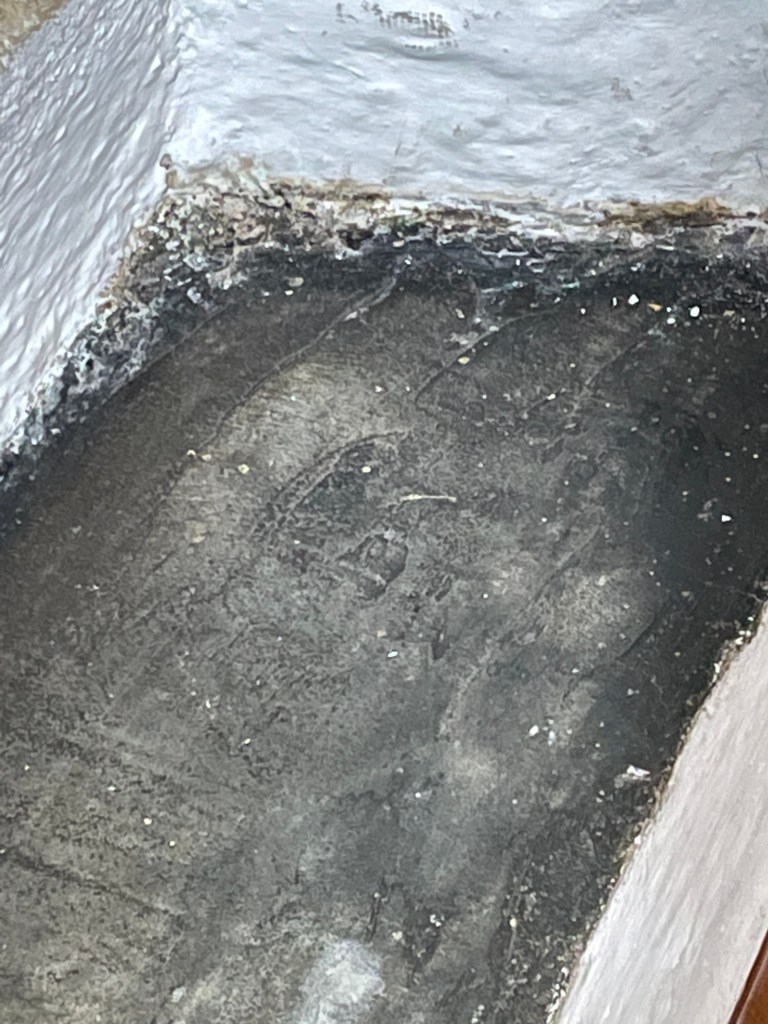
Once Miguel arrived and opened up the door to the infamous Casa de las Caras, my first impression is that the house was not haunted, in the classic sense. There was no electric energy, no sense of being watched, no strong emotions connected to the space; it was quiet, like a memorial to a past that had left only traces behind. At first, none of us could see the faces. Miguel, after the obligatory introduction and history lesson, used a pointer to show us where eyes, noses, chins, and hairlines were etched into the cement. For all three of us, there was this moment when the faces started to emerge from the cement like fast-blooming flowers. Where there had been almost nothing before, faces popped out everywhere. I was taking photos all over the two rooms, seeing new faces even as I returned to the same spot I had been moments before.

This was beyond anything I have experienced before. Faces were appearing before my eyes. Not only was I not straining to see anything, I could not keep up with the sheer number of odd forms. Here are some of the photos I took:

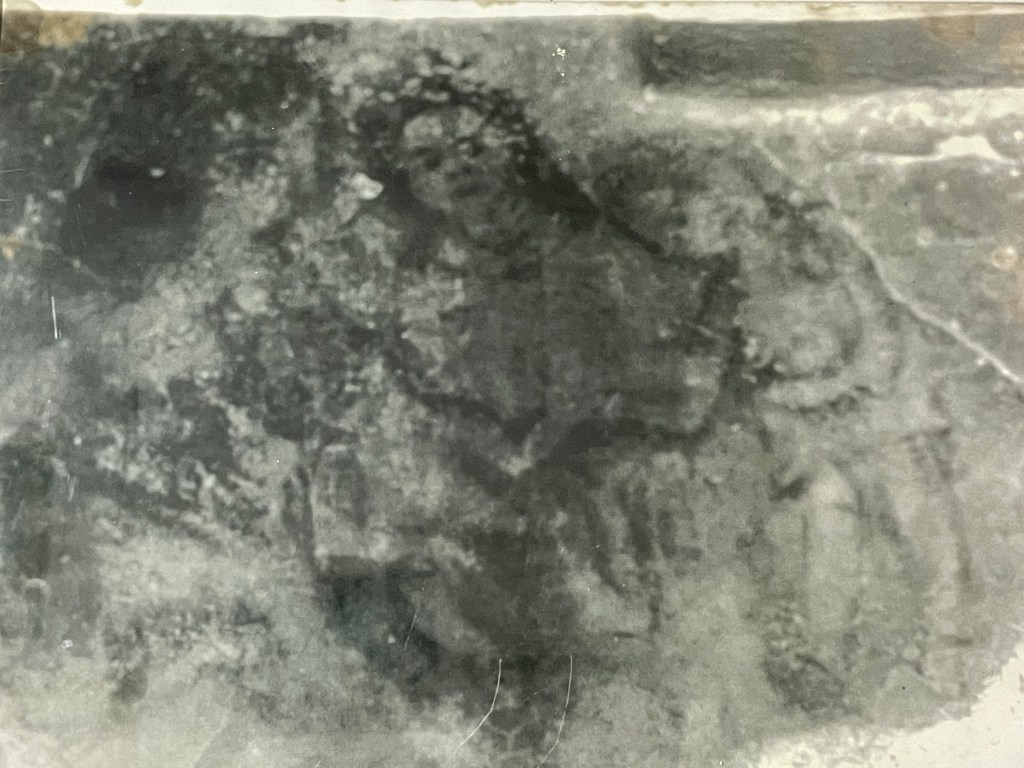
THIS IMAGE IS NOT FROM MY CAMERA, BUT IS ON THE WALL AS ONE OF THE ORIGINAL, FAMOUS FACES (and I believe that this image was doctored)

We made a generous donation to Miguel and proceeded to argue about the faces and figures for the next hour as we headed to Jaén. My brother in law swears that his cement floor has faces, too, and that this is all a hyped-up case of “pareidolia” or the human propensity to see faces everywhere (we are hard wired for facial recognition even when there are no faces to be seen). Plus, he said, it’s not haunted. I agree with him on the last opinion, but pareidolia has its limits, too–sometimes, there is a face in the damn floor. My husband remained agnostic on this issue, thinking that fraud was involved, and indeed, there have been accusations of tampering with the cement floor with paints and other chemicals to “enhance” a subtle pattern that might have been there. There was little doubt that some of the historic photos of the faces had been traced with pencil or paint so that they would stand out, but . . .

Some of those faces were neither pareidolia nor produced via fraud. Something strange was happening at that house.

As Ty and I were scrolling through our photos, something odd had happened: the faces that were so clear at the house had vanished in the photos, even though we reviewed our photos at the house and saw the faces more clearly in the photos than on the floor. Where had they gone upon review at our hotel? At least 50% of the photos no longer showed any evidence of the original faces. And weirder yet, as I reviewed the photos today that had “lost” the original faces and figures, I found new faces; faces that I had never seen before. I can see them in the photos above.

Miguel said that the “caras” would transform over time. He swears that one set of figures not only changed over time, but the children grew up between the first photos and the last, taken years later. That strains credulity, I know; however, what does seem to be true is that the faces morph and evolve, appear and disappear, with no known cause.

As is typically the case, you can choose your explanation and be right. Or be wrong. You could call all of this a case of “pareidolia” and be justified in your position. You could say that something authentically paranormal is happening, and you would also be right. You can accuse the family of fraud and profit taking (although the condition of the house and the pueblo in general strongly argues against that), and maybe you would be onto something. Or not. My husband suggests that there is a spirit or paranormal energy in the house that affects what you see and manipulates your senses. I tend to agree with that, because something is altering your perception after a few minutes in that house. Try as I might, I do not see a proliferation of faces in my kitchen floor, or anywhere else. But there, it was a phenomenon impossible to deny. It happened to all of us.

I am actually desperate for comments on this post, as I am still attempting to make sense of what we all saw. I don’t mind skeptical comments, or wild theories, because I have no explanation for La Casa de las Caras.

–Kirsten A. Thorne, PhD
What if Your Paranormal Experiences are Connected to Childhood Emotional Abuse?

Exploring paranormal beliefs in subjects with a history of trauma, abuse, and/or neglect.

If you grew up like I did, moving from place to place, even country to country, you know what instability feels like. If you grew up ignored, abused, or traumatized by dysfunctional parents, you know what fear feels like: fear of intimacy, fear of abandonment, fear of disease, death, bullying, and a general sense that you are not safe. If you do not feel safe anywhere, and especially if this sense was accompanied by extraordinary experiences, this post is for you.

There are many respectable (read: university-research based) articles published on the relationship of “paranormal beliefs” and a childhood history of trauma. This is an enormously complex topic, one that requires multiple posts to simply introduce the concept. I have included the abstract of one such article at the end of this post, which claims that a belief in witchcraft is strongly correlated to a history of abuse. Their take on this correlation has to do with the need to control one’s environment, and the occult arts promise a level of mastery over one’s environment via spells, rituals, and occult practices.

Trauma in childhood manifests in various ways. I, for one, never found witchcraft to be appealing, in spite of a difficult upbringing where I was more often than not, left to my own devices. There are other theories: a belief in the paranormal comes from the ability to dissociate and disconnect from one’s violent or upsetting reality, creating the necessary conditions for an alteration of consciousness conducive to tuning into other worlds. Yet, dissociation is often treated like a symptom of mental illness rather than a tool to connect with other worlds. The default, academic assumption is that those alternate realities do not exist independently of our chaotic mental processes. Yes, some people dissociate due to mental illness; however, others discover that this power to leave the current reality leads to other realms of existence. We can argue about the objective reality of those experiences, or we can accept that some level of dissociation is necessary to enter these alternate realities.

Other academic approaches center on the idea of escape, of leaving one’s normal awareness behind to “run away” to other dimensions. I have never felt that I can “escape” to other worlds at will; maybe others can, but what is lacking in these articles are interviews with the experiencers themselves, to see how they understand their relationship to the paranormal. Without their words and input, the theories remain theories, based on surveys and not in-depth discussions. Materialism, clearly, continues to dominate our understanding of reality; there is (still) no room for any epistemology that allows for non-material experiences. The bias is to see experiencers of the paranormal as deluded, mentally ill, or psychologically unstable. I have yet to see research that takes their perceptions seriously.

I take most peoples’ experiences with the paranormal quite seriously, and the majority of us are not suffering from delusions or mental illness. I believe that a history of abuse, neglect, and traumatic experiences predisposes one to notice what others usually miss. When you learn how to “read the room” in any situation, you become acutely attuned to subtleties of gesture, expression, body language, tone, inflection, and energy. This intense attention to detail, to taking in the entirety of a situation, allows us to perceive the possibility of danger or distress far sooner than anyone else would. We grew up in worlds where negative emotions could and did explode into violence, where tense words could lead to abuse and manipulation, and where disagreement might lead to punishment.

When you develop the skill of reading others’ energy, you don’t shut off that skill when you are alone. Your antennae are always up and actively searching out signals. This is why, for example, I can walk into a house and know immediately that something terrible happened there, or know that a non-material person is standing near me, or pick up messages from the departed. If you become exquisitely sensitive to signals, to energy, to subtle vibrations in your environment, you learn that you are not limited to the material world. All the worlds become accessible.

I do not believe that I am deluded, nor mentally unstable, nor “predisposed” to fantasy or irrational desires for personal control. However, if your philosophy doesn’t allow for any reality that the one you can perceive with five senses, then the perception of alternate realities becomes a symptom of an ill mind. The paranormal will never find academic respect as long as we interpret its perception and experience as a result of psychological imbalance or a projection of unmet needs.

I long ago understood that there was little point in relating my paranormal experiences, as nothing would convince a skeptic or a committed materialist that my stories were objectively true. Extraordinary experiences become simple entertainment or fodder for arguments and fruitless debates on the nature of reality. One recent example of this was the nighttime torture of being kicked, pinched, awakened, and generally not allowed to sleep. My husband blamed me. However, I was awake when he bolted upright, insisting that I had pinched or kicked him. He heard three knocks at the bedroom door when I was upstairs. Something whispered in his ear when I was out of the house. However, to admit that something paranormal is happening to us is impossible if you refuse to take such experiences at face value: it had to have a “rational” explanation. These events must have had a logical, objective cause. Otherwise, we are in that fuzzy territory of the unexplained and the impossible.

The issue of the nighttime “attacks” was resolved by moving downstairs. We simply do not discuss it. This is the usual fate of paranormal experiences; they are either attributed to one’s fragile psychological state, or they are ignored as not worthy of serious study.

Is it true that many of us were raised in a state of fear and insecurity? Is it true that we lived through chaos and learned to pay close attention to details that most don’t perceive? Yes, it seems that we share certain characteristics. We often don’t feel safe and struggle with grief and tragedy. Instead of concluding from this that we are irrational and disconnected from reality, perhaps the truth is the opposite: we have seen the worst of human nature, and we are therefore highly sensitized to energetic frequencies and hidden worlds. We perceive more because there is more to perceive. We are more connected and more rational than those who see only a fraction of the multiple dimensions that form the matrix of our reality.

–Kirsten A. Thorne, PhD

Childhood physical abuse and differential development of paranormal belief systems

Stefanie L Perkins 1Rhiannon Allen

Affiliations Expand

This study compared paranormal belief systems in individuals with and without childhood physical abuse histories. The Revised Paranormal Belief Scale and the Assessing Environments III Questionnaire were completed by 107 University students. Psi, precognition, and spiritualism, which are thought to provide a sense of personal efficacy and control, were among the most strongly held beliefs in abused subjects, and were significantly higher in abused versus nonabused subjects. Superstition and extraordinary life forms, thought to have an inverse or no relation to felt control, were the least strongly held beliefs in abused subjects, and, along with religious beliefs, did not differ between the two abuse groups. Witchcraft was unexpectedly found to be the most strongly held belief among those with abuse histories. Results suggest that by providing a sense of control, certain paranormal beliefs may offer a powerful emotional refuge to individuals who endured the stress of physical abuse in childhood.

Swinger Road: The Demonic Proves its Power

The “Paranormal Nightmare” brothers endure a personal and traumatic demonic encounter.

Before I begin, here is the video in question. I highly recommend watching it in its entirety, but you could also skip to around 19 minutes, 50 seconds:

I do not recommend videos on YouTube very often at all, nor do I typically endorse a paranormal group (besides the Paranormal Housewives), but this video comes from one of the most trusted and honest groups I have yet to encounter. When there is nothing happening, there is no invention or fakery, or even exaggeration; that, for me, is the mark of a good team: do not lie to the public. However, “nothing happening” is about as far opposite of what happens here as you could imagine.

One might criticize the so-called “ghost hunting apps”, but they either say something meaningful for the context of the investigation, or they do not. If they nail the context of what is happening at the moment they produce a word or a sentence, then I don’t much care how the ghost app works; anything can be manipulated by subtle energies to make meaningful statements. Obviously, if the words or strings of phrases are nonsensical or have no meaning for the context of an investigation, I don’t attempt to force meaning; but there are times when something that is stated in this fashion is utterly correct for the circumstances of the investigation or, as in this case, for the personal history of the investigators. I will not spoil the video by revealing anything here, but suffice to say that the combination of a severe temperature drop, the emotional oppression surfacing in two of the brothers, the knocking, and the stunning words coming through the Ghost Tube, this is one of the best and most affecting moments recorded by a paranormal group.

I would very much like to know what you all think of this video. Please leave a comment and let me know your thoughts.

–Kirsten A. Thorne, PhD

If You Are Haunted

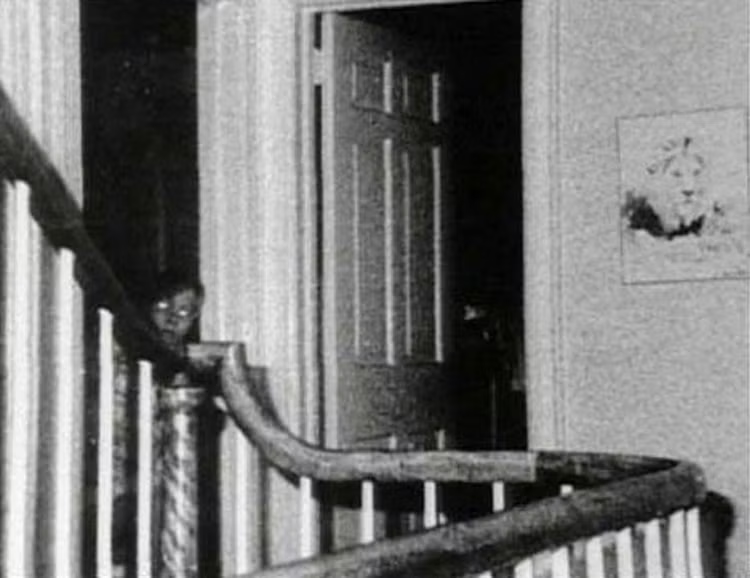
The Amityville Ghost

We tend to think that ghosts are either souls “out there” that have drifted into our homes and sacred spaces, or that something about us, our emotions, have disturbed the physical world. We divide our reality into neat categories: us and them. Spirit and matter. Light and dark. Our energy versus their energy.

When it comes to the paranormal, it’s not that there are two explanations: either trauma and fear, or an outside being invading a home. The trauma and fear invite in the entities, the spirits, the beings, or the demons. Trauma opens the portal, sends out the signals, and what comes in either shares in the pain, attempts to resonate with that pain, or takes advantage of the emotional chaos in order to inflict further damage to already fragile psyches.

There is not one explanation for a haunting, but rather multiple ones. We think that we are different from the ghost, that we are of another order, when in fact, we are in their world and they are in ours. We are the same. Our grief, fear, depression, and guilt open the doors to all the unseen energies that pervade the dimensions of our reality.

For grief, the solution is love beyond death.

For fear, the solution is action.

For depression, the solution is creation.

For guilt, the solution is forgiveness.

None of it easy; none of it without great effort. We spend lifetimes addressing these issues, and from our pain the ghosts flow in.
Those ghosts can be human, demonic, alien, or some other entity that we have yet to categorize; yet we are the ones who summon them, whether we know it or not. We ask for their presence, for they are the tools of our spiritual awakening, for our healing of soul and spirit.

And some of us do not heal, do not wake up, and head into the dark with them. We will try again; there is always a next time.

Some of us try to run from the truths of our existence, the sense of falling into nothingness when we realize that we are the spirits and they are us, and there is nothing final about death, beyond our thoughts that something must end; at the very least, our suffering.

And that can end, that suffering, but only in the acknowledgment that love is what and who we are, and everything else is illusion, the smoke and mirrors of the human condition.

If you are haunted, you are invited to heal from the worst of your pain, to endure the dark night of the soul, the walk into the pitch black and return with your essential, beautiful, forever life.

If you are haunted, accept the invitation to find out who you really are; who we all are. There is light at the end of everything that appears to be a tunnel. You are the light. And so are they.

What it Would Mean to Never Die

Cool Worlds: Quantum Immortality With Professor David Kippling

My thoughts on this video come down to one idea: how do we know who we are? What constitutes identity? Why are we not, in some way, everyone else? If consciousness is the substrate of reality, as many physicists and philosophers have considered, then isn’t our “uniqueness” and our “free will” merely a persistent illusion?

The “many worlds” theory assumes that there is a stable, self differentiated identity that can travel from branch to branch, somehow maintaining its age, physical characteristics, and mental processes in a coherent and continuous transference. This, however, is probably not the truth of the matter. If you introduce reincarnation into this many worlds view, then “you” could be almost anyone; the missing ingredient is awareness. Awareness of yourself as a separate and unique being travels along the many branches of the infinite worlds, but that does not equate to you looking or appearing the same in these various realities. You can “feel” yourself as a separate entity identified with who you think you have always been, and yet you could appear on the outside as a different being.

Bring time into this equation, and things get more bizarre. If the block universe is correct, as many physicists now accept, then time is irrelevant. All things happen at once: your youth, your maturity, your old age. Why then, would you be constrained by your age in one branch of the universe? After all, what ages us is not time, but entropy–and that emerges in a local, closed system that we experience in very particular conditions. If you head out into another branch of the universe, then why would you necessarily be the same age or subject to the same conditions that you were in the “here and now”?

Essentially, however, we don’t know what consciousness is, or why we perceive ourselves as individuals with a unique history and set of experiences. If we can’t define who “we” are, then how would we know who, or what, is replicated in the multiverse? All that matters is that we–whatever we are–PERCEIVE a continuity of identity, regardless of whether or not such a continuity has actually happened (and how would we define and measure such a concept?). Our perception of ourselves as special universal patterns of being is the only thing that must be present for immortality to feel authentic.

In other words, we are immortal as long as we accept that consciousness isn’t a special property that somehow belongs to us as individuals. Consciousness is a property of the universe itself, and we neither possess it or lose it. It simply shifts from one perceived location to another.

—Kirsten A. Thorne, PhD

The Apocalypse

My husband and I returned from Spain on December 11th, 2024. My parents caught Covid. At 85, that remains a frightening diagnosis. I watched them carefully for signs of low blood oxygen or dramatic fatigue. During that time, the wildfires in Los Angeles started. I had thought that there was some hyperbole attached to the warnings, but I was wrong. Our house in the middle of nowhere lost all power for many days, and even when the power was restored, it would flicker off an on, rendering our internet useless and working from home impossible.

We were in the middle of moving from our tiny condo to a less tiny rental apartment, and ash fell around us as we lugged boxes from one place to the next. I had strange, physical ailments that I am still recovering from–headaches, respiratory issues, and eyes that won’t focus correctly.

The day before Trump’s inauguration, in the middle of packing and running from fires, a member of our family had a complete breakdown and was admitted to the hospital. On Inauguration Day, he was admitted to a “behavioral care facility”, or what used to be called a psych ward. As he ruefully put it, “they should turn off the news. That’s what landed many of us here in the first place”. And he does not exaggerate, really, for he and his fellow patients are in the target demographic for Trump’s hatred and lack of compassion: gay, trans, and non-binary kids who now feel utterly betrayed and unsafe.

While we were back and forth to the facility where he stayed for a week, we were packing and navigating fires and poor air quality still; and then, on a Sunday, I received frantic messages from my husband. He had fallen off a ladder while packing up his workshop, smashing the back of his head and lower spine. When I saw him, I almost passed out. He was covered in blood and unsteady on his feet. I drove like a maniac to Urgent Care, and they sent him to the emergency room, which, of course, is where I should have gone in the first place. I was out of my mind with fear and panic.

We moved to the rental apartment, the fires were extinguished, the family member went to an outpatient program, but the fallout continues. The damage from the fires is hard to describe; entire neighborhoods disappeared. The damage to my family member is ongoing, as well, as he calls almost every day in a state of anxiety and despair. My husband’s broken scalp is recovering, and the fact that his concussion was fairly mild is a miracle. And for that, I am grateful.

The damage that Trump seeks to inflict on the Constitution, on democracy, and the whole concept of federal government, is just starting. His fans are seeing his actions as exciting and bold, without really understanding the consequences. This is not about politics anymore, but about remaking the United States into an oligarchy, an authoritarian state. That seems to be just fine for some; but for most of us, that is absolutely terrifying. Our country, the one we have known since we were children, is under attack. The climate is changing so fast that we barely have time to recover from one disaster before another one hits.

When you combine the small-scale tragedies with the large-scale ones, mental health declines across the board, leading to a paralysis that the current Administration is counting on in order to crush the opposition and drain us of any fight. It seems to be working, so far.

The Apocalypse is not a big, showy battle between warring forces; turns out, it is the gradual loss of willpower and the sense of defeat that turns into depression, resulting in good people giving up and handing power to the demagogues and grandiose narcissists. It’s family in the psych ward, unable to connect to a reality that is far too painful to manage; it’s accidents and fires and floods, sapping our vitality and courage. It happens when there is nothing left to do but try to survive.

Spirituality, a sense that there is something far larger than this, might be the only way to survive. But right now, in spite of the purpose of this blog to discuss and analyze all things non-material and mysterious, all I can feel is darkness and limitation.

Comments would be most appreciated.

–Kirsten A. Thorne, PhD

They Want Us Stupid and Addicted

This isn’t about politics. In fact, I think perhaps politics might be the greatest distraction ever invented. The “culture czars” tell us how to spend our time, what we should care about, and treat us as stupid children, because we have become exactly that by consuming the products that they are selling.

Social media and “news” have become the single, greatest evil in my life. I don’t write because I am scrolling; I don’t engage with people or pursue my passions because I am worrying about my skin, my turkey neck, the war in Gaza, the war in Ukraine, whether or not my wardrobe matches, fires around my house, air quality, face yoga, the climate tipping point having been reached and surpassed, the best cat bed (and I don’t have a cat), the end of democracy, and the “what kind of witch are you” quiz. Everything is presented in quick sound and vision bites that make everything seem equal in importance. There is no sense of urgency or outrage about Gaza because right after gazing at the dead bodies of children, we see ads for workouts and shoes, and because social media is designed to distract and addict us, we forget the horrors of war. AND THAT IS PRECISELY THE POINT.

What better way to keep a population apathetic, unengaged, and uninterested than creating an addiction to quick information, shiny objects, and scrolling, repeating, memes? It rewires your brain fairly quickly, to the point that you can no longer read novels (the attention span is gone) or anything longer than one paragraph.

Worse than that, social media and infotainment create a low-level anxiety that feeds the addiction. You keep scrolling to soothe yourself, but the effect is to amp up that anxiety to the point of anguish for people already susceptible. Over the long haul, depression emerges, as nothing about the smart phone is truly engaging on a human level. Our brains are not designed for this onslaught of distracting images and sounds contained in a tiny screen, and we suffer for it.

This is the express intention of the social media/tech billionaires. This is how they maintain and grow their empires, gain and abuse their power, and control our attention spans. In my life, the effect has been catastrophic for my mental health, my creativity, my happiness, and most of all, for my spiritual life.

This is ironic, of course, as I need to depend to a certain extent on social media to advertise a post; however, I don’t write much because I am glued to the horror stories online, and terrified of my own aging and mortality, because the messages I receive daily are: be afraid, very afraid, for the world is in a death spiral, and that death spiral includes you. And, if you do nothing to save the children of Gaza, you are not only apathetic, you are evil. What ensues is guilt over the effects of war and a total inability to act, due to that guilt and the continual distraction of social media that tells me, daily, that I am fading away and dying, and the solution is face cream that costs $250 a month. I learn that I am a bad person for not saving the world, and that I must spend a great deal of money if I don’t want to age and die.

Of course, death is everywhere, all of the time. It dances along with life, zig-zagging from one side to the other. Another odd effect of social media is the total denial of death while at the same time, stoking an extreme fear of it. S0cial media exists to maintain a constant, low-level hum of fear and anxiety, and that has the effect of destroying one’s spiritual life, distancing one from a sense of community, and draining all the joy and excitement of the world outside of the screen. I have found myself too distracted to meditate, to pray, or to write. I careen from one disaster to the next, not even sure what is true, or real, or something that I can do anything about. If it’s not fear and loathing, it’s guilt; what a perfect combination for depression and inaction. Our crippled mental health, however, is exactly what maintains the billions of the trio above and their godfather, Trump, among, of course, many others regardless of their politics.

So now, to save myself, I must disconnect from all of it. I will advertise this post, because for anyone to read what I am saying, I have to use the tools of the oppressor. Outside of that, I am forcing myself to break the addiction, the trance, the stupor, of social media and the ridiculous pretense that it is useful for engaging with world conflicts and tragedies.

I have few friends, am losing my ability to focus, to create, and to engage, exactly what the elite social media gurus wanted to happen all along. But that stops today, right now. I refuse to sacrifice myself and the years I have left to an addiction that paralyzes me. This is about the human spirit, after all–the greatest victory for those who made their billions from social media and news is to know that they have bought our souls.

The purpose of this site and soulbank.org was to explore and illuminate the life of the spirit. I will return to that mission and break the addiction, if not for others, than at least for myself.

–Kirsten A. Thorne, PhD

Is the Paranormal a New Religion? Peter Laws and the Spiritual Quest Culture

Peter Laws

I rarely ask anyone to watch a video, but if you are interested in the paranormal, if you consider yourself to be on a spiritual quest, if you are neither religious nor atheistic but consider yourself spiritually inclined or fascinated by the supernatural, then please, watch the video below. In it, Peter Laws talks about the “in betweeners” who do not attend formal church services, but also do not consider themselves “disbelievers”. They are open minded, curious about what lies “out there”, and seek evidence for their beliefs instead of relying on faith. Ironically, states Laws, this is the group of people most likely to fear death. Committed believers of all faiths do not worry about death, as their faith in the afterlife is strong; committed atheists do not attach meaning or transcendence to the biological processes of birth and death, and are therefore unconcerned about moral and/or ethical belief systems that require codes of conduct and adherence to rites and rituals. It is the vast numbers of people who don’t identify with either extreme who fear death the most, and they are the ones most likely to pursue interests in the paranormal and other spiritual topics.

Peter Laws argues for a more inclusive community that both embraces traditional religious systems and beliefs while simultaneously opening up to the many people who are looking for answers that can be verified, or at the least, for which evidence can be found. The ghost hunt might be the new Mass, but that idea for most Christians is repellent and ‘sinful’. That disdain that organized religion proclaims for anything paranormal is reflected in the paranormal communities’ distrust of anything religious. For them, God is a ridiculous fantasy, but fairies and Slender Man are quite real (Laws).

I encourage all of you reading this blog to please watch all of Law’s video, as I truly believe you will find it fascinating; and also, more importantly, because this topic is truly important for all spiritual seekers, regardless of how we find transcendence. I will be writing much more about Law’s video in future posts.